
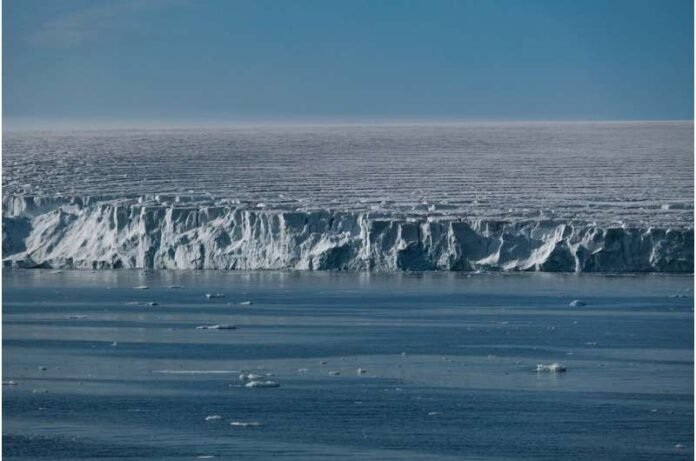
Rivers in the sky bringing moisture to Antarctica during the Southern Hemisphere winter help explain short-term peaks in the world’s average temperature, new research has found.
Global daily temperature records were set and broken regularly in 2024, which remains the hottest year on record, followed by 2023 and 2025, with 2026 on track to rank among the four warmest years.
One troubling landmark in particular stood out in 2024, with Earth’s hottest individual day on record occurring on Monday, July 22, when the global average surface air temperature reached 17.16°C (62.9 degrees Fahrenheit) in the ERA5 dataset used by the Copernicus Climate Change Service.
While scientists have extensively studied year-to-year changes in global average temperature, much less attention has been paid to why it fluctuates from one day to the next.
In what the researchers describe as the first systematic investigation of these daily variations, work led by members of 21st Century Weather based at the University of Melbourne has highlighted the major role Antarctica plays during the Southern Hemisphere winter. The research is published in the journal Environmental Research Letters.
They found that increased moisture transport toward Antarctica generally preceded peaks in daily global average temperature during these winter months.
Conversely, dips in the global average were often preceded by reduced moisture transport toward the frozen continent.
A similar pattern emerged when the researchers examined atmospheric rivers: long, relatively narrow bands of intense moisture transport that can carry warm, moist air toward Antarctica.
Antarctica experiences exceptionally large temperature swings during winter, giving it an outsized influence on these daily fluctuations in the global average.
Much of the continent can remain well below freezing while becoming substantially warmer than usual. When that warming extends across a large enough area, it can push up the global average temperature.
“Atmospheric rivers are often associated with heavy rain, but they also carry warmth and moisture,” said Dr. Kim Reid, a research fellow with 21st Century Weather.
“When they reach Antarctica in winter, the warmer air and associated cloud cover can raise temperatures substantially. The continent can still be bitterly cold, but that warming can be large enough to register in the global average.”
Associate professor Andrew King, a chief investigator with 21st Century Weather, said, “Human-caused climate change is raising the background global temperature, while weather adds short-term ups and downs.
“Our research helps explain those daily fluctuations. It shows how weather over the coldest continent can contribute to some of the hottest days recorded for the planet as a whole.”
Publication details
Andrew King et al., Atmospheric rivers associated with daily global temperature spikes and dips, Environmental Research Letters (2026). DOI: 10.1088/1748-9326/aec3c6
Journal information: Environmental Research Letters