
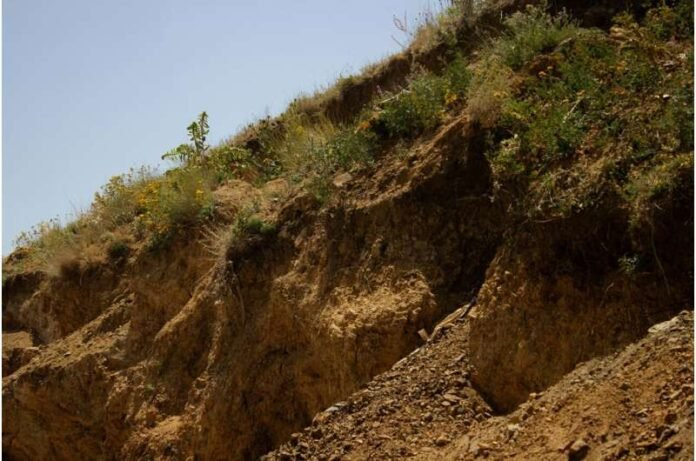
Rain and wind erode fertile soil worldwide. The topsoil, where plants take root and where most of the nutrients are found, is washed away from fields by heavy rain, particularly on slopes and where the ground is not covered by vegetation. Once washed away, it takes a very long time to reform—spanning decades to centuries. To estimate how much soil is lost, researchers use computational models.
Globally, the so-called Universal Soil Loss Equation and its revised version, known as (R)USLE, are very frequently used for this purpose. They were derived from measurement plots primarily in the Midwestern and Southern United States. “When applied to tropical and subtropical regions, they usually yield elevated, and in some cases catastrophic, erosion rates, which are often not supported by data,” says Dr. Pedro Batista.
As part of his Emmy Noether Junior Research Group at the University of Augsburg, he is investigating soil erosion in the tropics. “One reason is that deeply weathered tropical soils react differently to erosion than the soils for which the formula was developed.
“A similar thing happens to rainfall characteristics, crops, and land use practices: the (R)USLE does not travel well to the Global South without substantial adaptation, though this is largely ignored.”
A thought experiment with the tables turned
Together with researchers from Germany, Uganda, the U.K., Brazil, Belgium, Australia and the U.S., he points out in a commentary in the journal Nature Geoscience that the calculation formula used worldwide—which is based on U.S. data—produces unreliable figures in the Global South.
The team raises the question of whether the scientific community would accept the reverse scenario: a model developed in India that calculates alarmingly high erosion rates for Europe and North America. The researchers interpret the fact that such results are often adopted uncritically for the Global South as a consequence of neocolonial biases within the geosciences. In their view, flawed figures can steer policy in the wrong direction and leave vulnerable communities unprotected.
Local measurements rather than a one-size-fits-all formula
The authors expressly do not wish to downplay the problem of erosion in the Global South. They call on academic journals, peer reviewers and funding organizations to critically examine the use of such models outside their intended scope. At the same time, they should provide greater support for local measurements and new approaches developed by researchers from the Global South. Affordable sensor technology and photogrammetry now offer good opportunities for this. Model results should also be presented as a range rather than a single value.
Batista is also investigating what such approaches might look like in his own research: Since March 2026, he has been leading an Emmy Noether Junior Research Group, focusing on soil erosion in the tropics, with a particular emphasis on the Brazilian Cerrado.
Publication details
Pedro Velloso Gomes Batista et al., Decolonize soil erosion modelling, Nature Geoscience (2026). DOI: 10.1038/s41561-026-02124-9
Journal information: Nature Geoscience