
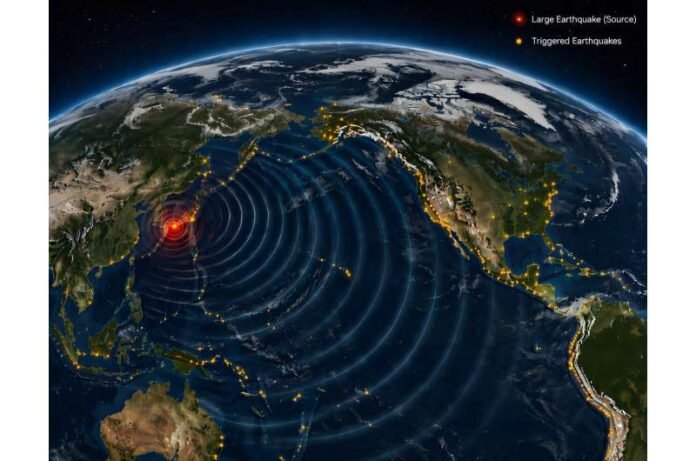
Major earthquakes can sometimes set off seismic activity thousands of kilometers from their original location, and new research may finally explain why these distant events occur, sometimes long after the initial earthquake has ended.
A research team led by Professor Jun Yang at the University of Hong Kong (HKU) has identified a possible mechanism involving changes in fluid pressure inside fault zones. The findings, published in Science Advances, could provide answers to two long-standing questions in earthquake science: why remotely triggered earthquakes can be delayed and why certain seismic waves appear more effective at initiating them.
The study focuses on fault gouge, a layer of loose, granular material found along geological fault surfaces. Using a new analytical framework and computer simulations, researchers examined how this material responds when seismic waves pass through it.
Their results indicate that even relatively small disturbances can gradually increase the pressure of fluids trapped within the fault material. As this pressure rises, the forces keeping the fault stable become weaker, potentially making it more likely to move.
Importantly, this weakening process does not necessarily end when the seismic waves disappear. Increased fluid pressure can persist, leaving the fault in a vulnerable condition and potentially explaining why some earthquakes occur considerably later.
The researchers also discovered that compressional components of seismic waves contribute more effectively to this pressure buildup than shear components. This could explain why Rayleigh waves appear to trigger distant seismic activity more frequently than Love waves, despite the latter producing greater theoretical shear stresses.
According to Professor Yang, the findings introduce a broader way of understanding remote earthquake triggering, highlighting the combined roles of geological material behavior, fluid dynamics and seismic wave propagation.
The research offers a new scientific framework for investigating how major earthquakes can influence fault systems far beyond their immediate surroundings.