
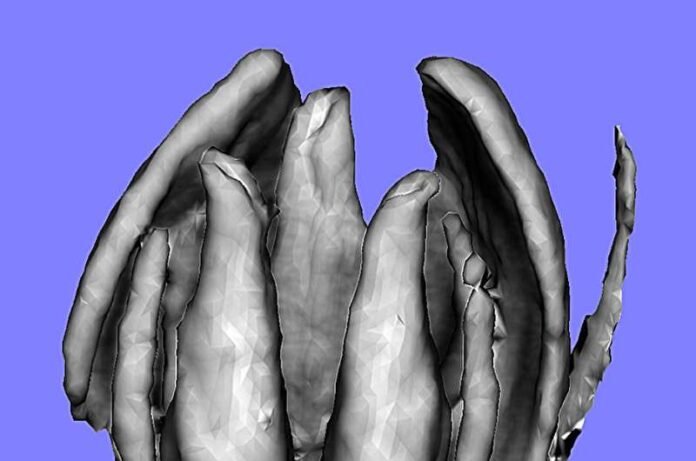
A remarkable discovery has revealed a tiny flower that remained hidden inside a rock for more than 100 million years. Using advanced X-ray technology, scientists have uncovered an exceptionally preserved fossil that could provide important clues about the early evolution of flowering plants during the age of dinosaurs.
The fossil, named Tomlinsoniella pedicellata, was discovered unexpectedly inside a sandstone specimen collected more than 130 years ago in Kansas, United States. The rock belongs to the Dakota Formation, a geological deposit well known for preserving ancient plant remains.
The discovery was made by researchers examining historical museum collections. Although the specimen had been preserved for more than a century, its remarkable contents remained unnoticed until modern scanning technology revealed what was hidden inside.
The research, published in the American Journal of Botany, involved scientists from the United States and the United Kingdom.
A discovery made with advanced X-ray technology
Professor Steven Manchester, a paleobotanist at the Florida Museum of Natural History, was originally examining the sandstone specimen to investigate another fossil flower known as Dakotanthus.
During the examination, he used micro-computed tomography, an advanced imaging technique that employs X-rays to produce detailed images of structures hidden inside solid materials.
While scanning the rock, Manchester unexpectedly noticed another floral structure completely enclosed within the sandstone. Its distinctive shape immediately attracted his attention because it appeared to display the characteristic arrangement of a monocot flower.
He subsequently shared the images with colleagues, including botanist Walter Judd from the University of Minnesota and paleobotanist Bruce Tiffney from the University of California, Santa Barbara.
After examining the scans, the researchers recognized that the fossil represented an ancient palm-like monocot and consulted specialists in palm evolution at the Royal Botanic Gardens, Kew.
A flower smaller than a grain of rice
Despite its extraordinary age, the fossil is remarkably small. It measures approximately 1.5 millimeters in height and 1.2 millimeters in diameter, making it no larger than a grain of rice.
Its structure contains several important characteristics associated with monocot plants: three sepals, three petals, six stamens arranged in two groups of three, and three separate carpels, which are the female reproductive structures of the flower.
This particular arrangement is significant because it represents the classic structural pattern of monocot flowers.
The fossil was preserved in an unusual way. Rather than retaining the original organic material, the flower left behind a cavity inside the sandstone after its remains decomposed. Clay surrounding the plant helped preserve an exceptionally detailed impression of its original shape.
By using micro-CT scanning, scientists were able to reconstruct the internal structure and produce a three-dimensional representation of the ancient flower.
Possible connection to the ancestors of modern palms
Researchers believe that Tomlinsoniella pedicellata most closely resembles the flower of an extinct palm species, potentially belonging to the fan palm subfamily.
This interpretation makes the discovery particularly important for understanding the evolutionary history of palms and other flowering plants.
Monocots represent approximately 20% of all known flowering plant species. This extensive group includes economically and ecologically important plants such as bananas, cereals, orchids and lilies.
Although genetic evidence suggests that monocots originated during the Early Cretaceous, relatively few fossils from the middle Cretaceous period or earlier have been identified.
The newly discovered specimen therefore provides valuable evidence of what these plants looked like approximately 100 million years ago.
According to the researchers, it may represent the oldest known evidence of the characteristic monocot flower structure and could also be among the earliest fossil records associated with the fan palm lineage.
Professor William J. Baker, a co-author of the study and a senior research leader at the Royal Botanic Gardens, Kew, described the discovery as particularly exciting because the ancient flower looks surprisingly similar to plants that exist today.
He noted that finding such a well-preserved specimen could help scientists better understand one of the major unanswered questions in biology: when and how flowering plants first developed.
Museum collections continue to reveal prehistoric secrets
Beyond its importance for plant evolution, the discovery demonstrates how modern scientific technologies can transform the study of historical museum collections.
The sandstone specimen had been collected during the late 19th century and remained preserved for generations without revealing the fossil hidden inside it.
Researchers believe that many other museum specimens could contain previously unidentified structures that modern imaging techniques may eventually uncover.
The findings also highlight the importance of combining traditional paleontological research with advanced digital scanning methods.
Although further investigations are necessary to establish the precise evolutionary position of Tomlinsoniella pedicellata, scientists say the discovery provides a significant new piece of evidence about the development of flowering plants during the age of dinosaurs.