
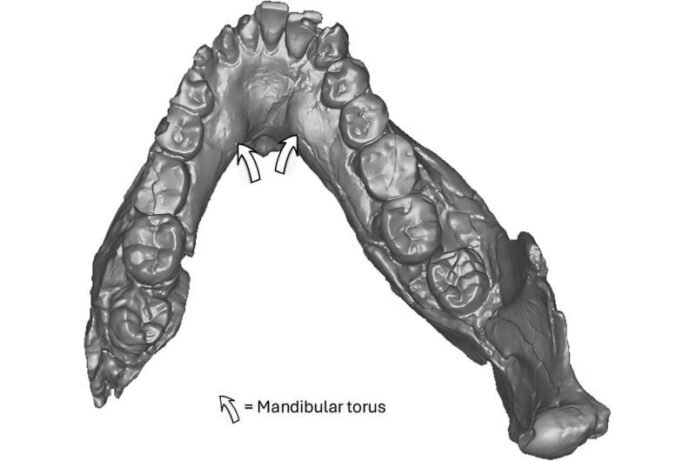
An Ancient Jawbone Discovery Uncovers an Anatomical Mystery That Still Puzzles Scientists Today.
A distinctive anatomical feature, frequently encountered by dentists but rarely documented in human fossil remains, has been identified in an ancient skull, offering new insights into a medical phenomenon that dates back more than 2 million years.
Researchers from La Trobe University have discovered a prominent mandibular torus in a fossil belonging to Australopithecus africanus, unearthed at Sterkfontein in South Africa. This condition is characterized by a harmless bony growth along the inner surface of the lower jaw.
The fossil, identified as Sts 52b, is estimated to be between 2.8 and 2.1 million years old. According to researchers, it belonged to a young individual, as indicated by the presence of fully developed second molars and third molars that had not yet completely emerged.
Although mandibular torus is relatively common among modern humans, scientists have not yet established exactly what causes it. One hypothesis suggests that it may develop as a result of prolonged mechanical pressure on the jaw, including intensive chewing and teeth grinding over many years.
The discovery has surprised researchers, particularly because the pronounced bone formation was already fully developed in such a young individual.
“Finding such a pronounced, fully formed ridge in a young fossil specimen, where no other juvenile fossil of its kind shows it, is extraordinarily unexpected,” said Luca Morris-Obst, the lead researcher and a Ph.D. student at La Trobe University.
He added that the finding offers a more relatable perspective on our ancient ancestors, demonstrating that even young hominins experienced harmless anatomical variations similar to those still encountered by people visiting dentists today.
The research group, which also included La Trobe researcher Dr. Jesse Martin and former university student Georgia Taylor, highlighted the importance of the discovery by comparing it with other ancient human relatives.
One particularly interesting comparison involves Paranthropus robustus, a species characterized by exceptionally strong jaws, large teeth and anatomical adaptations designed to withstand considerable chewing pressure. Despite these characteristics, researchers have not identified mandibular torus in any known specimens of this species, including both young and adult individuals.
This comparison raises questions about the long-standing assumption that intense chewing activity is the main factor responsible for the development of this bony formation.
The lead researcher explained that even hominins with powerful chewing muscles and exceptionally robust jaws did not necessarily develop this feature. This indicates that mechanical pressure from chewing, on its own, cannot fully account for its appearance.
The study, published in the journal Evolutionary Human Sciences, points toward a more complicated explanation for the development of the human jaw.
According to the researchers, a combination of genetic inheritance, environmental influences and functional factors could contribute to the formation of mandibular torus. However, the precise mechanism behind its development remains unknown.
The Sts 52b fossil is considered one of the oldest and most clearly defined examples of this anatomical feature discovered in the hominin fossil record, pushing evidence of its existence back more than 2 million years.
Possible earlier examples have also been identified in fossils of Australopithecus afarensis discovered in Hadar, Ethiopia. However, researchers describe those cases as considerably less pronounced, making the newly examined Sts 52b specimen a particularly significant discovery.