
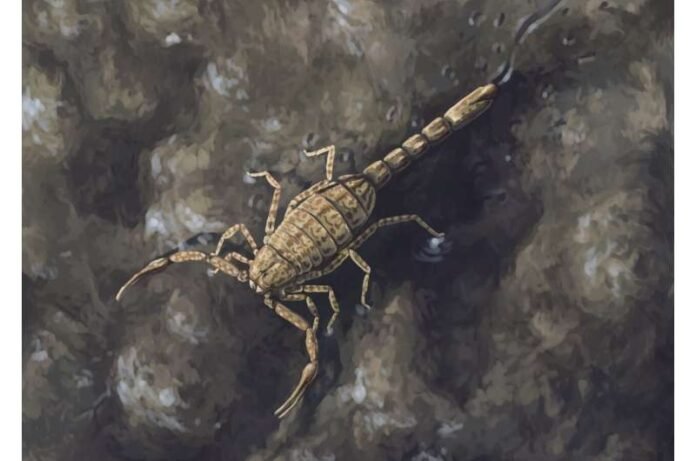
A remarkably preserved fossil dating back more than 310 million years has provided scientists with new insights into the evolutionary history of scorpions, revealing that some ancient species already possessed physical characteristics remarkably similar to those of their modern relatives.
The small fossil was discovered in a coal deposit in Alabama, in the southeastern United States. Researchers from Flinders University, working alongside specialists from the University of Alabama and the American Museum of Natural History, examined the specimen to better understand the early development of these ancient arachnids.
The scorpion lived during the Carboniferous Period, long before dinosaurs appeared on Earth. Its discovery offers valuable evidence about an animal group that has survived for hundreds of millions of years while retaining many of its characteristic physical features.
The research, published in the journal The Science of Nature, focuses particularly on the relatively small size of the fossil and its striking resemblance to scorpions living today.
Genevieve (Gen) Conway, a paleontology honors student at Flinders University and the study’s lead author, explained that many arthropods living around 315–320 million years ago, including scorpions, millipedes and early relatives of dragonflies, were generally much larger than their present-day counterparts.
For this reason, researchers believe the newly examined specimen may have been a juvenile. It could also represent one of the earliest examples of its kind investigated in North America in connection with the evolutionary history of modern scorpions.
An ancient species with features seen in modern scorpions
Despite its considerable age, the fossil displays several anatomical characteristics familiar in scorpions today.
Its body includes a relatively broad and developed metasoma, the elongated rear section that carries the venomous stinger, together with comparatively small and narrow pincers.
According to researchers, this particular combination of features is also found in some living scorpion species that rely heavily on venom for defense and capturing prey. These animals often feed on small insects capable of moving quickly.
The fossil’s eye arrangement also provides important clues about its evolutionary position. Although scorpions can possess between six and 12 eyes, the researchers noted that the placement of one pair in this specimen is slightly farther forward than would normally be expected in modern scorpions.
This suggests that the animal may not fit entirely within the group that includes today’s scorpions.
Conway pointed out that the ancient creature nevertheless bears a remarkable resemblance to species currently found around the world, including in Australia. Its appearance may have been particularly similar to members of the genus Lychas, a group frequently encountered by hikers in Australia.
A fossil discovery from an overlooked location
The specimen was recovered from the Pottsville Formation at the Union Chapel Mine in Alabama, an area that has not received extensive attention from paleontologists.
Dr. Russell Bicknell, a senior author of the research and a researcher at Flinders University’s College of Science and Engineering, emphasized the importance of investigating fossil locations that have remained relatively unexplored.
He explained that this is among the first scorpion fossils from the site to receive detailed scientific examination, despite the area having previously produced numerous fossilized trackways and other prehistoric remains.
Bicknell also highlighted the contribution of amateur fossil collectors and citizen scientists, noting that important discoveries can emerge from locations that are close to local communities.
The researcher believes that the Pottsville Formation and similar geological sites around the world may still contain numerous fossils capable of providing new information about ancient ecosystems.
The fossil had initially attracted Bicknell’s attention during earlier work involving experts from the American Museum of Natural History, when he was also investigating scorpion trackways at the Union Chapel Mine Paleozoic footprint site.
What the discovery tells us about scorpion evolution
The findings provide another piece of evidence in understanding how scorpions evolved and why their basic body structure has remained recognizable over such an enormous period of geological time.
The researchers say that additional specimens from museum collections and previously overlooked fossil deposits could help clarify the evolutionary relationships between ancient scorpions and the species that inhabit the planet today.